
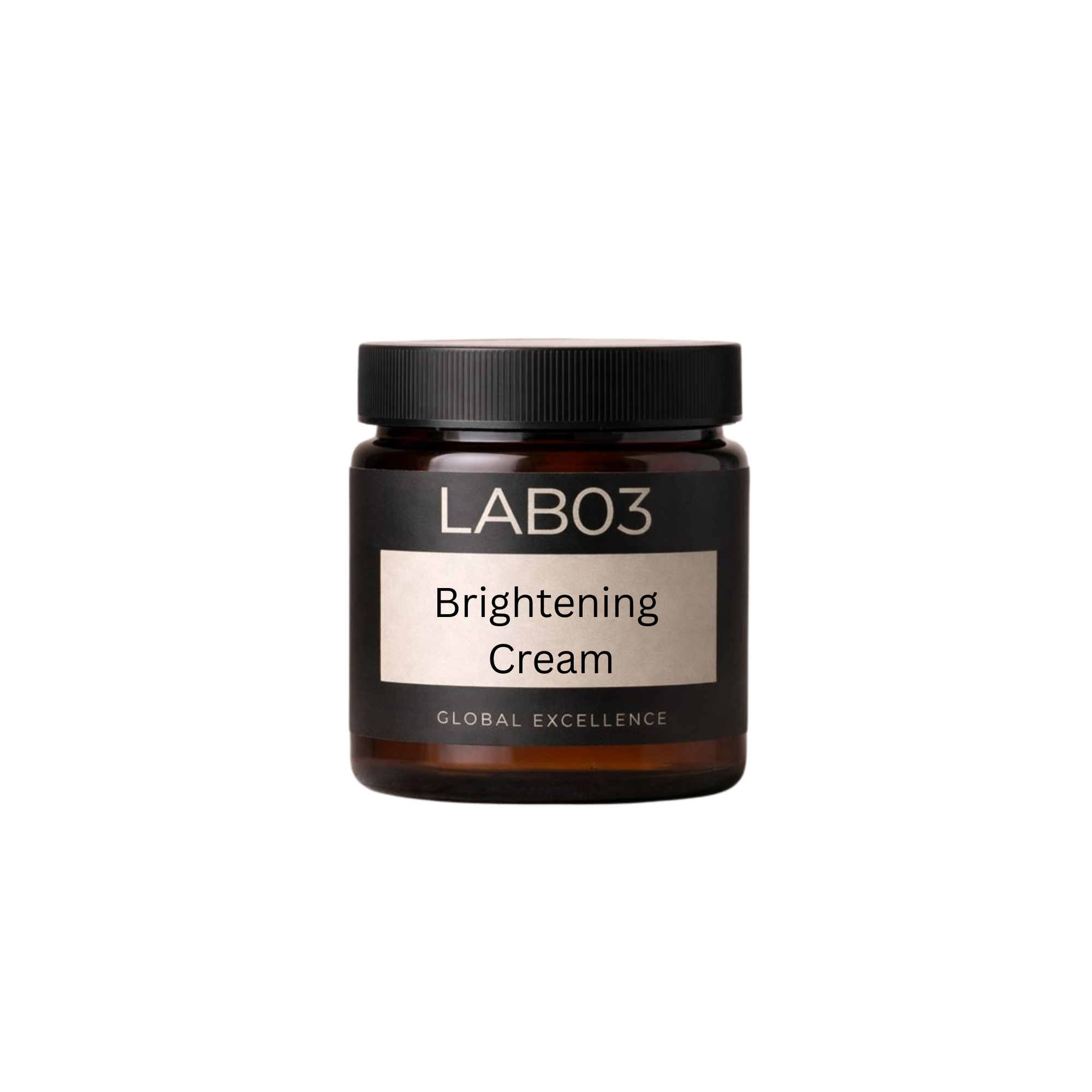
Brightening Face Cream — Private Label Skincare UAE
Additional information
A clinically positioned brightening face cream formulated in three selectable active tiers — from gentle daily brightening through to intensive clinical-grade hyperpigmentation correction. Every tier built on the same premium moisturising base of hyaluronic acid, niacinamide, ceramides, and Olivem 1000. Branded entirely as your own.
MOQ
Flexible
Turnaround
2-4 weeks
Quote
Within 24-48 hrs
Export
UAE · GCC · EU · USA
Free Formulation on orders above 20,000 AED ($5,500). T&C apply.
GMP-ISO 22716
Certified
ISO 14001
Environmental
Made in UAE
Sharjah
GCC Compliant
Export ready
About this formulation
Hyperpigmentation — melasma, post-inflammatory hyperpigmentation (PIH), solar lentigines, and uneven skin tone — is the single most prevalent aesthetic skin complaint in the UAE and GCC dermatology clinic. The combination of year-round UV index 10–12, Fitzpatrick skin types III–VI in the majority of the population (which are inherently more prone to pigmentation disorders), hormonal influences, and the incomplete or inconsistent use of sun protection creates a chronic pigmentation burden that standard imported brightening products consistently underperform on. The LAB 03 FZC brightening face cream is engineered specifically for this market and this skin population.
The formulation architecture separates the brightening active system from the moisturising base — allowing the same premium cream base (hyaluronic acid, ceramide NP, Olivem 1000, squalene, panthenol) to carry three distinct and clinically differentiated brightening tiers. Tier 1 (Niacinamide + Alpha Arbutin) is positioned for daily use, clean beauty certification, and retail brands wanting gentle brightening with strong ingredient recognition. Tier 2 (Vitamin C + Kojic Acid) is positioned for results-focused clinical and premium retail use, where a more aggressive brightening outcome is expected within the 4–8 week clinical timeframe. Tier 3 (Glutathione + Alpha Arbutin) is the GCC whitening market formulation — responding directly to the cultural and commercial demand for glutathione-led skin whitening products that is specific to the Gulf market and is not addressed by any standard imported brand.
Across all three tiers, the brightening actives are delivered in a face cream base specifically formulated for Fitzpatrick III–VI skin types common in the UAE — with ceramide NP for barrier repair (darker skin types have inherently higher TEWL in compromised states), dual hyaluronic acid for deep daily hydration, and fragrance-free formulation as standard (fragrance is a known trigger for post-inflammatory hyperpigmentation and is contraindicated in any brightening protocol). Every tier is fully customisable and available with dermatologist-tested and fragrance-free claims.
Manufactured under ISO 22716 GMP in Sharjah, UAE. Export-ready for UAE, GCC (including Saudi SFDA), EU, and USA. Request a quote within 24–48 hours — samples of all three tiers available before production commitment.
Key benefits
- Three selectable clinical brightening tiers — choose based on target market, claimed intensity, and regulatory environment
- Specifically formulated for UAE and GCC skin types — Fitzpatrick III–VI, high UV, humidity, and post-inflammatory pigmentation patterns
- Premium moisturising base across all tiers — hyaluronic acid (dual MW), ceramide NP, squalene, and Olivem 1000 emulsifier
- Fragrance-free as standard — fragrance is a known PIH trigger; all tiers are unscented to protect the brightening protocol
- Clinically substantiated actives — all three tier active systems are supported by peer-reviewed clinical literature at the concentrations used
What's Inside?
Tier 1 Active — Melanosome Transfer Inhibitor
Niacinamide
At 5% concentration, niacinamide inhibits the transfer of melanosomes (melanin-containing vesicles) from melanocytes to keratinocytes — reducing the amount of pigment deposited in the skin's surface cells without affecting melanin production itself. This makes it the safest and most universally applicable brightening mechanism available, as it does not interfere with the melanocyte's normal UV-protective function. Additionally at 5%, niacinamide reinforces the skin barrier by stimulating ceramide synthesis, regulates sebum, reduces redness, and improves skin texture — making it the most commercially versatile brightening active for a broad retail audience.
Tier 1 Active — Tyrosinase Inhibitor
Alpha Arbutin
Alpha-Arbutin Alpha arbutin inhibits tyrosinase — the enzyme that converts tyrosine to DOPA and DOPA to melanin — by competing for the enzyme's active site without permanently inactivating it. It is the refined, more stable, and more effective form of arbutin (versus beta-arbutin), with a slower hydrolysis rate that reduces any potential conversion to hydroquinone in use. At 1% in Tier 1 and 2% in Tier 3, alpha arbutin provides complementary tyrosinase inhibition alongside niacinamide's melanosome transfer inhibition, creating a two-mechanism brightening system in a single formula. Widely accepted in EU, UAE, and GCC markets with no regulatory restrictions.
Tier 2 Active — Antioxidant Brightening
Vitamin C (Stable Derivative)
Ascorbyl Glucoside or Ethyl Ascorbic Acid At 10% using a stabilised derivative (ascorbyl glucoside or ethyl ascorbic acid — significantly more stable than pure L-ascorbic acid in a cream formula), Vitamin C delivers antioxidant protection against UV-induced free radicals that trigger melanin production, direct tyrosinase inhibition, and reduction of already-formed melanin through its mild oxidation reduction properties. In the UAE high-UV environment, the antioxidant component is particularly important — Vitamin C directly counteracts the reactive oxygen species that translate UV exposure into melanin stimulus. The chosen stable derivative avoids the formulation challenges (low pH, oxidative instability, orange discolouration) of pure L-ascorbic acid in a cream system.
Tier 2 Active — Tyrosinase Chelator
Kojic Acid
Kojic Acid Derived from the fermentation of Aspergillus and Penicillium species, kojic acid inhibits tyrosinase by chelating the copper ions that the enzyme requires for its catalytic activity — a different inhibition mechanism from alpha arbutin's competitive inhibition. This means kojic acid and alpha arbutin (used together in Tier 2 combination variants) provide synergistic inhibition at different enzyme sites, achieving a stronger combined effect than either alone at the same concentrations. At 1–2% in a cream formula, kojic acid is within the EU Cosmetics Regulation's accepted cosmetic use range. It has a strong clinical evidence base for melasma and solar lentigo correction.
Tier 3 Active — Melanin Pathway Switch
Glutathione
Glutathione (L-Glutathione) Glutathione operates on the melanin pathway at a fundamentally different level from all other brightening actives — it does not inhibit tyrosinase or block melanosome transfer, but instead switches the type of melanin produced. By scavenging reactive oxygen species and binding to the copper centre of tyrosinase, glutathione shifts melanin synthesis from eumelanin (dark brown/black) toward phaeomelanin (light yellow/red) — literally changing the colour of melanin produced rather than reducing the quantity. This makes it the most comprehensive brightening mechanism available and explains the strong consumer demand for glutathione in the GCC market, where it is recognised as the most potent available brightening active. At 2% in a topical cream formula, combined with Alpha Arbutin and Niacinamide, it creates a three-mechanism brightening system that addresses the melanin pathway at synthesis, type, and transfer levels simultaneously.
Hydration — All Tiers
Hyaluronic Acid (Dual MW)
Sodium Hyaluronate — High & Low Molecular Weight Dual-molecular-weight hyaluronic acid is present across all three tiers as the primary hydration active — it is particularly important in a brightening face cream because dehydrated skin with a compromised barrier is significantly more prone to PIH. Surface-level hydration alone is insufficient in UAE conditions; the low MW component penetrates to the upper dermis for deeper, sustained moisture that maintains barrier integrity throughout the brightening protocol. Well-hydrated skin also responds more consistently to brightening actives — dehydration slows cell turnover and reduces the speed at which treated pigmented cells are shed from the surface.
Barrier — All Tiers
Ceramide NP
Ceramide NP Darker skin types (Fitzpatrick III–VI) — the majority of the UAE and GCC population — have a higher susceptibility to barrier disruption and post-inflammatory hyperpigmentation precisely because any barrier insult triggers an inflammatory response that stimulates melanocyte activity. Ceramide NP in the brightening cream base performs barrier repair that actively reduces the PIH risk from the daily inflammatory triggers of UAE life: hard water washing, UV exposure, and heat-induced barrier stress. A brightening cream that does not repair the barrier is working against itself — the ceramide component ensures that the anti-inflammatory and barrier-protective function is built into the formula, not added as an afterthought.
Emulsifier — Premium Biomimetic
Olivem 1000
Cetearyl Olivate, Sorbitan Olivate Olivem 1000's biomimetic lamellar structure improves active penetration — particularly important in a brightening formulation where the actives must reach the basal layer of the epidermis (where melanocytes reside) to be effective. A standard emulsifier system keeps actives dispersed in the cream but does not optimise their skin entry. Olivem 1000's lamellar structure aligns with the skin's own lipid bilayer, improving the rate and depth of active penetration without requiring carrier technologies or enhanced delivery systems. This is the technical quality distinction that separates a premium brightening cream from a standard supermarket brightening product with the same active ingredients listed.
Emollient — All Tiers
Squalene (Plant-derived)
Squalene Plant-derived squalene mirrors the skin's own sebum fraction — providing the light, non-comedogenic emolliency appropriate for a face cream targeting hyperpigmentation (many patients with melasma also have sebaceous skin, making heavy emollient systems counterproductive). Its biomimetic identity means it integrates into the skin's lipid film without creating a separate occlusive layer. Its antioxidant properties contribute a passive secondary mechanism against UV-induced melanin stimulus, working in synergy with the active brightening system.
Barrier & Cell Renewal — All Tiers
Panthenol (Vitamin B5)
Panthenol (D-Panthenol) Panthenol's cell renewal stimulation is particularly relevant in a brightening protocol — accelerating the natural desquamation process that removes melanin-laden surface cells progressively shortens the visible improvement timeline. Combined with the active brightening agents suppressing new melanin production and transfer, faster cell turnover provides the third mechanism of brightness improvement: faster removal of existing pigment from the visible skin surface. This is why brightening face creams with panthenol show faster clinical results than identical formulations without it, even though panthenol itself has no direct anti-melanin mechanism.
Full INCI list available once the formula and sample are approved. Formula can be adjusted to include or substitute any active
Make it yours — full customisation available
Formula customisation
Tier 1: Niacinamide 5% + Alpha Arbutin 1% (standard) / elevate to 8% Niacinamide Tier 2: Vitamin C stable derivative 10% + Kojic Acid 1–2% (selectable concentration) Tier 3: Glutathione 2% + Alpha Arbutin 2% + Niacinamide 4% Cross-tier additions: Tranexamic Acid / Azelaic Acid / Licorice Root Extract Retinol (0.1–0.3%) available as evening-use variant upgrade for Tier 2 and 3 Fragrance-free as standard across all tiers (strongly recommended)
Packaging Options
Airless pump jar (recommended for Vitamin C and Glutathione tiers — oxidation protection) Wide-neck glass jar (Tier 1 — clean beauty aesthetic) Tube (travel / clinic dispensing format) Sizes: 30ml · 50ml · 100ml Material: glass · PET · HDPE · Eco-recycled PCR White / frosted / matte black — clinical aesthetic options
Label & Branding
Full custom label design · Your brand name, logo, clinical identity Arabic + English labelling standard for UAE · French available “Dermatologist tested” · “Fragrance-free” · “Clinically formulated” claims Tier-specific claims: “Brightening” / “Correcting” / “Intensive whitening” Full CPSR, INCI list, safety data sheets for each tier SFDA registration support for Saudi and GCC market clearance
Add-on Avtices from our Bank
Texture: light cream (normal/oily skin) / richer cream (dry skin, mature skin) SPF addition: available for Tier 1 (day cream with SPF 30 or 50 built in) Hyaluronic acid concentration: standard / elevated for dry skin Ceramide level: standard / elevated for post-procedure or eczema-adjacent skin Retinol (PM): 0.1% (starter) / 0.3% (clinical) — evening variant only Eye cream variant: smaller jar, adjusted texture for periorbital use
Ideal for your sector
Hotels & Resorts
Not Ideal
Spa & Wellness Centers
Retail anchor for brightening treatment menus Medical spas offering brightening facial treatments — HydraFacial brightening boosters, vitamin C infusion facials, glow peels — can dramatically increase retail conversion by offering a branded brightening cream that clients take home to continue the results between visits. The Tier 2 (Vitamin C + Kojic Acid) formulation is specifically aligned with the vitamin C facial treatment narrative. Available in a premium airless pump jar under the medical spa's brand — a high-value, credible retail product at AED 80–150 that reinforces the brand's clinical authority.
Gyms & Fitness Clubs
Not Ideal
Clinics & Medical Centers
The prescribed post-procedure home care protocol Clinics performing laser, chemical peel, microneedling, and IPL on UAE skin types III–VI require a clinic-branded brightening cream as post-procedure home care — both to maximise treatment outcomes and to manage PIH risk. A branded brightening cream with your clinic's name, the correct active tier for the procedure performed, and fragrance-free formulation is a credible, clinically aligned product that patients will purchase on prescription and reorder consistently. Tier 3 (Glutathione + Alpha Arbutin) is the recommended post-laser protocol cream for darker skin types. Tier 2 (Vitamin C + Kojic Acid) for melasma maintenance between peel sessions.
Retail Brands
The GCC brightening market opportunity The GCC brightening skincare market is one of the largest and fastest-growing skincare segments in the region — driven by a population with high melanin production, strong UV exposure, and significant cultural premium placed on even, bright skin tone. A private label brightening face cream with a clearly communicated active tier, clean clinical packaging, and correct SFDA registration is a commercially strong proposition for UAE pharmacy retail, concept stores, and e-commerce. Tier 1 for broad retail; Tier 3 for the GCC whitening segment that international brands consistently underserve.
Who we also service
Our range covers corporate gifting programs · Airline amenity kits · Real estate developer handover gifts · Subscription box brands · Yacht & marine hospitality
Product Specifications
| Product type | Skin care — brightening face cream / hyperpigmentation correction moisturiser |
| Target skin concern | Hyperpigmentation · Melasma · Post-inflammatory hyperpigmentation (PIH) · Uneven skin tone · Solar lentigines |
| Target skin types | All Fitzpatrick types; Tier 3 specifically formulated for Fitzpatrick III–VI (UAE and GCC primary population) |
| Tier 1 actives | Niacinamide 5% + Alpha Arbutin 1% — gentle daily brightening, clean beauty compliant |
| Tier 2 actives | Vitamin C stable derivative 10% + Kojic Acid 1–2% — results-focused correction, 4–6 week timeline |
| Tier 3 actives | Glutathione 2% + Alpha Arbutin 2% + Niacinamide 4% — GCC intensive whitening, clinical supervision recommended |
| Shared base actives | Hyaluronic Acid (dual MW) · Ceramide NP · Squalene · Olivem 1000 · Panthenol · Allantoin · Glycerin |
| Fragrance | Fragrance-free as standard across all tiers (fragrance is a known PIH trigger — not recommended) |
| Texture | Light to medium-rich cream — adjustable for normal/oily or dry skin variants |
| Available sizes | 30ml · 50ml · 100ml |
| Packaging formats | Airless pump jar (recommended for Tiers 2 and 3 — oxidation protection) · Wide-neck jar · Tube |
| MOQ | Flexible — available on request per tier |
| Production lead time | 2–4 weeks from formula approval |
| Shelf life | 24 months (unopened, stored away from direct light; airless pump packaging extends Tier 2 and 3 stability) |
| Preservation system | Phenoxyethanol + Ethylhexylglycerin (paraben-free; compatible with all three active systems) |
| Free-from | Fragrance-free · Paraben-free · Sulphate-free · Cruelty-free · Mineral oil-free · Hydroquinone-free |
| Hydroquinone-free | Yes — all three tiers formulated without hydroquinone; compliant for unrestricted cosmetic use in UAE, GCC, EU |
| Dermatologist tested | Available — clinical testing protocol on paediatric skin panel can be arranged |
| Certifications | ISO 22716 GMP · ISO 14001 · EU Compliant · SFDA · USFDA |
| Regulatory support | Full CPSR, INCI list, certificates of analysis, SFDA registration support provided per tier |
| Halal availability | Yes — on request; all tier formulations can be produced under halal certification |
| SPF variant | Tier 1 with SPF30 or SPF50 available — one-step brightening day cream with sun protection |
| Export markets | UAE · GCC · Saudi Arabia · EU · USA · Worldwide (regulatory documentation varies by active tier and market) |
| Sampling | Samples of all three tiers available on request before production commitment |
| HS Code | 3304.99 — Beauty or make-up preparations and preparations for the care of the skin |
| Manufactured in | Hamriyah Freezone Phase 2, Sharjah, United Arab Emirates |
Ready to launch this body lotion under your brand?
Receive a no-obligation quote within 24–48 hours.
Frequently asked Questions
Which tier is right for my clinic or brand?
The choice depends primarily on your target consumer and regulatory environment. Tier 1 (Niacinamide + Alpha Arbutin) is the correct choice for broad retail, e-commerce, hotel skincare ranges, and brands requiring EU and international clean beauty compliance — gentle, safe for all skin types, and commercially versatile. Tier 2 (Vitamin C + Kojic Acid) is the clinical choice for aesthetics clinics and medical spas where a measurable correction outcome within 4–6 weeks is the expectation — appropriate for melasma maintenance and PIH correction protocols. Tier 3 (Glutathione + Alpha Arbutin + Niacinamide) is specifically positioned for the GCC market where glutathione-led skin whitening is a primary consumer demand — the highest-intensity formulation, recommended for use under clinical supervision or dermatologist guidance. We recommend requesting samples of all three before choosing — the formulation difference is immediately perceptible in skin feel and the visual skin results within a two-week sample trial.
How does glutathione work differently from niacinamide and vitamin C?
Glutathione operates at a fundamentally different point in the melanin production pathway from all other brightening actives. Niacinamide blocks melanin transfer from the melanocyte to the surface skin cells. Vitamin C and kojic acid inhibit tyrosinase — the enzyme that produces melanin. Glutathione does neither of these: instead, it switches the type of melanin produced. By scavenging reactive oxygen species and binding to the copper site of tyrosinase, glutathione shifts melanin synthesis from eumelanin (dark brown-black) to phaeomelanin (light yellow-red) — literally changing the colour of melanin the skin produces rather than reducing the quantity. This makes it the most comprehensive mechanism available and explains why it is particularly valued in the GCC market for intensive skin lightening. In Tier 3, all three mechanisms are combined — switching melanin type (glutathione), inhibiting tyrosinase (alpha arbutin), and blocking melanosome transfer (niacinamide) — for the most complete three-pathway intervention available in a cosmetic face cream.
Why is the formula fragrance-free?
Fragrance is one of the most well-documented triggers for post-inflammatory hyperpigmentation, particularly in Fitzpatrick III–VI skin types — the UAE and GCC target population for this product. Fragrance compounds (particularly linalool, limonene, and citral) activate mast cells in the dermis when absorbed through the skin, triggering a low-grade inflammatory response that stimulates melanocyte activity. In a skin that is already being targeted with brightening actives to suppress melanin production, adding a fragrance that stimulates melanin production through inflammation is directly counterproductive to the formula’s purpose. All three tiers of this brightening cream are fragrance-free as standard — not as a consumer preference feature, but as a clinical formulation decision. This is one of the details that distinguishes a clinic-grade brightening formulation from a retail product that adds a pleasant scent for consumer appeal without considering the PIH implications.
Does this formula contain hydroquinone?
No — all three tiers are formulated without hydroquinone. Hydroquinone is restricted from cosmetic use in the EU (maximum 0.5% rinse-off only), restricted in the UAE and GCC for OTC cosmetic use, and classified as a drug in the USA (requiring prescription above certain concentrations). Our brightening tiers use the current generation of proven cosmetic alternatives — niacinamide, alpha arbutin, kojic acid, stable vitamin C, and glutathione — that collectively address the melanin pathway at multiple points without the regulatory restrictions or the potential ochronosis (blue-black skin discolouration) associated with prolonged high-concentration hydroquinone use. For any market where hydroquinone is being used in clinical treatment (under prescription), our brightening cream serves as the maintenance and home-care product between clinical sessions — the combination of prescription hydroquinone treatment and cosmetic brightening maintenance is a common and effective clinical protocol.
Is SPF really mandatory — or is it just a recommendation?
In the UAE UV index 10–12 environment, SPF is genuinely mandatory for any brightening protocol to deliver lasting results — not a recommendation. The mechanism is straightforward: melanocytes respond to UV exposure by producing melanin as a photo-protective response. If a patient applies brightening actives that suppress this response but then goes outdoors without SPF, the UV stimulus is strong enough in UAE conditions to regenerate the suppressed pigmentation within days — faster than the brightening actives can correct it. The brightening cream suppresses the melanin response; the SPF removes the stimulus for that response. Without both, the protocol is incomplete and results will be partial and temporary. This is why we recommend clinics prescribe both products together — and why LAB 03 FZC manufactures a matching private label SPF50 sunscreen that can be co-branded and co-sold as a two-product brightening protocol under a single brand identity.